Pages

Saturday, 8 March 2014

Twinstar backseating and an open day

Yesterday a friend of mine was kind enough to let me backseat his second ever DA42 flight, which involved circuits under VFR conditions. We were in ZK-CTH, which is the first Twinstar to have received the new CTC livery. He practised both normal and flapless circuits, with a go around thrown in for good measure! Some non-standard right hand circuits were also practised, as was a rejected takeoff. During the stop and go, the instructor asked for short a field landing and take off which really gave a sense of the power the aircraft has. I just cannot wait to get to fly one myself!


Can you spot Clearways?


Today was also the CTC Hamilon training centre's open day, meaning about 150 people visited the airport to have tours of the building as well as listen to a talk from both CTC and the guest airline, who today was Jetstar. Hopefully a useful day to all the guests! 

Oh and me being me, of course I snapped some photos in the hangar as I passed through it. 
New colours on a Cessna


Friday, 28 February 2014

Cross Country

So I recently completed my cross country qualifier, a big step in the VFR training. The flight needs to be at least 300 miles long and you must land at 2 airfields (at least 1 of them needs to be controlled) and have signatures from either the tower or somebody at the airfield to prove you have been there.

The flight had been cancelled a fair few times due to weather, as of course you need to make sure that the conditions are going to be fine not only for a large area, but also for a long period of time (you are 'given' the aircraft for about 6 hours).

I planned a route up north to Dargaville, which is in the Northland, before heading across to Great Barrier Island, tracking south from there to Tauranga and then back to Hamilton. The two airports I chose were Dargaville, which is an uncontrolled airfield and Tauranga, a controlled one.

On the leg to Dargaville it was necessary to make a slight change of course in order to avoid a military no-fly zone (probably for the best!!!) and arrived at Daraville on time, although the weather had slightly deteriorated since I took off from Hamilton. I did an overhead join before landing on the limestone runway. It was very narrow and throws up a lot of dust! However, the bonus is that it is very difficult to miss, as it is brilliant white against the grass surroundings. I stayed at the airfield chatting to some members of the flying club before heading off on the rest of my journey.

I reached the coast where I was to begin the crossing to Great Barrier Island, although had to plan a re-route, as the cloud base was too low for me to reach a safe altitude - you need enough height to be able to glide to land in the event of an engine failure; on this occasion, the necessary altitude was 8500ft. Instead, I planned a route south, pretty much via Auckland and cautiously made my way through all of the airspace changes in the area. The views here were incredible and I was able to see Auckland up close from 900ft in the air!

I then tracked across to another small aerodrome at Thames and once there went north to Coramandel in order to pick up my original track from Great Barrier. On reaching Tauranga I landed and visited the tower which was great. They showed me all of their equipment and how they manage all of the traffic, before demonstrating to me how they can see the details of pretty much any aircraft flying in New Zealand. Incredible, especially when it turns out that the equipment is about 12 years old.

After refuelling and filling out the necessary paperwork, I began the home stretch back to Hamilton. The flight is only around 20/25 minutes, so it was much shorter than any of the other sectors.

All in all it was a great day and one of the most enjoyable flights I have had yet. It was very exciting to make full stops at airports and explore instead of doing touch and goes and was rewarding knowing all of the preparation for the flight paid off.


CTC Aviation is currently re-branding, meaning that the logo and a few things are looking different. The yellow/gold has disappeared, giving way to silver and a different shade of blue. We are receiving new epaulettes and tie and the aircraft are being repainted. So far a Twinstar has left the hangar in the new colours and many other aircraft in the fleet have been painted white in preparation. A few new Cessnas are making their way into the fleet as well, as we say goodbye to the conventional C172s. How do you like the new livery?!


Thursday, 30 January 2014

Flying update

Hi! Thought I would do an entry on all of the flying I have been up to in January - which is quite a lot! I now have exactly 40 hours in my logbook, all on the Cessna 172S. The flights have pretty much been half dual, half solo; 16.1 hours of the 40 are solo.

So after my first solo, there were lots more circuits to be done! The lessons were called "circuit variants" and included flapless landings and glide approaches. The flapless landings aren't too bad, as the only difference really is the aircraft's attitude and the slightly higher speed. Glide approaches, however, are rather different to a normal landing. As you descend, you need to try and edge your way closer to the runway in order to make sure that you don't become too low. You then turn on to base a lot earlier than usual and if required, can use flaps. It is vey strange, as you have to have the aircraft in a nose down attitude until flaring height, meaning you are basically nose diving to the runway until the very last second!

Practice forced landings was one of the dual flights this month. This is naturally a very important lesson, as you do need to know what to do should you lose an engine or need to do an emergency landing away from an airfield. We simulate the engine failure after selecting a suitable field and then carry out the necessary procedures before going around at 500ft AGL (which is about 700ft indicated around here).

The next dual flight was steep turns, which is also a sort of mini test to make sure you are ready to go solo out of the Hamilton control zone. This lesson was good fun, as you get to throw the aircraft around a bit and experience a fair bit of positive G.

After this flight, it was the first out of circuit solo. For this we are expected to practice steep turns and PFLs during the 2 hour flight, before making out way back in to land.

Yet more circuits were next, before three general handling and circuits flights. During the general handling parts of the flight we could practice PFLs, steep turns and stalling. I found these flights useful, as you really get a feel for what the aircraft can handle, and get a big confidence boost when you make it in and out of the control zone without any issues!

There have been three instrument flights, which of course, are dual. My instructor first got me to close my eyes and face down, before doing various manoeuvres in the plane and asking me to tell him what I thought was going on. It is a very strange sensation and also surprisingly difficult. After this, I was given control and had to try and fly straight and level with my eyes shut. Again, this was tricky, as your body just isn't designed to be an aircraft instrument!
Flying with one of these on is certainly interesting!
The second lesson included compass turns, which is when you have to compensate for various errors by either over or undershooting the desired heading, before making slight corrections to get as accurate reading as possible. The third was my favourite - unusual attitudes! My instructor, Grey, had me put on the IFR hood as usual, before putting the aircraft into crazy attitudes. I would then have to recognise this attitude from instruments alone, before recovering and putting the aircraft back into straight and level flight. This flight was also where I had my first experience of negative G - weightlessness. It was absolutely great fun to feel myself hovering above my seat, as well as see my airport plates float into the air!

The past 4 flights I have done have all been nav flights. The first two are dual and the second two solo. These second flights are the same routes as the first two, although in reverse. The first one was basic enough, although I had a fair amount of turbulence going against me. The second, however, was different, as in the dual flight version, you are asked to divert at some stage in the flight, meaning you haven't seen the entire route until you go solo. At the time this seemed pretty daunting although after all of the preparation for the flight, you realise that all you need to do is trust your headings and you will be fine!

Both of my solo nav flights have been on ZK-JMY
Every day I get more excited about getting to fly one of these in the not too distant future!
The weather has been really nice over the past few days and I have seen some spectacular sights whilst buzzing around New Zealand. Just take a look at some of these photos:


Saturday, 28 December 2013

Christmas and some big news - my first solo!


Raglan beach - popped here on Christmas day!

My "I can't believe I just got to go solo" grin
Hey everyone! I've had some exciting flying lessons recently, mainly involving circuits here at Hamilton. There have been three lessons on the circuits, each bringing in a new element - for example, engine failures after takeoff. This is basically finding a field and aiming for it as if your engine has cut off.

The circuits here at NZHN are left hand, although I have had a couple of non-standard right hand ones thrown in at various points during the three lessons. I also came in behind an ATR72, which, it turns out, kicks out some crazy wake turbulence!

Today was very exciting - I completed my first ever solo flight! This morning I had lesson FK011, which is a solo check flight. This is when a certified instructor goes up with you and makes sure you
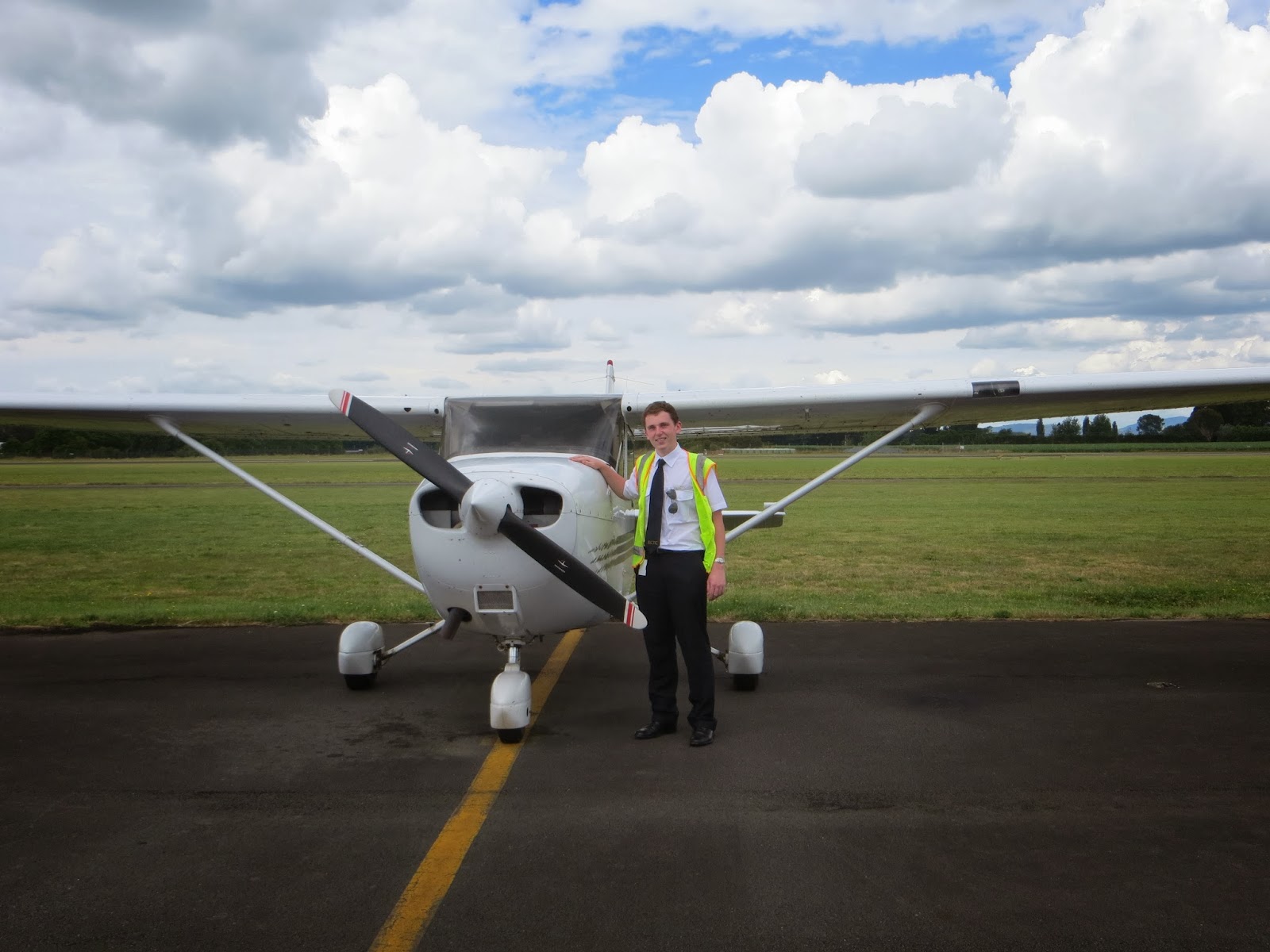
are performing to the expected standard. If all goes well, they hop out at the terminal and you go back to the runway and complete your very first solo! Luckily everything went smoothly today, despite the weather not being at its best and I flew a circuit by myself. Pretty sure I was grinning during the entire flight! On landing I was thrilled to get a "well done" from the control tower, before taxiing back to the CTC apron to refuel and shut down the aircraft. I genuinely think the hardest part of flying the Cessna is parking them! Unlike with the DA20s, you have to use a tow bar to control the nose wheel; pushing the aircraft and lining up the aircraft to be perfectly straight along the taxiway line is no easy feat. I know what you are thinking: "Oh what is he on about, it cannot be that difficult!". I thought that too, but it is actually surprisingly difficult! If I am honest it is still a bit surreal that after so long waiting for it, I have finally flown an aircraft all by myself - I have been waiting to say I have done that for years now! My next flight involves about an hour of solo circuits, so am really looking forward to that one!

ZK-JZM just after my first solo
Christmas in New Zealand was odd. The weather was the main abnormality, as the frost and wind etc was missing. However, unfortunately the grey clouds and rain decided to pay a visit. We had a Clearways Christmas BBQ before heading to Raglan beach for an hour or so which of course involved photos of us all on the beach in Santa hats! We haven't made any official plans for New Year yet, but hopefully we will get up to something exciting!


Thursday, 19 December 2013

Stalling and the C130


I had my sixth lesson yesterday, which was all to do with stalling. I had a mass brief in the morning before my flight, which was at 1215. Mass briefs are basically when a few cadets are booked in with an instructor to go over flying lessons which we will all be doing in the near future. Coincidentally, the one I had yesterday was on stalling!

My plane, ZK-JZM, was in maintenance, so we had to push the flight back slightly; as I would be the first flight of the day, this also meant I had to do a full preflight check. This involves checking the lights, flaps, airframe, fuel, oil, control surfaces etc to make sure everything is working as it should be.


Here are a few photos from the walk around...
During the walk around you have to check that everything is working and prepare the aircraft for flight

Making sure the flaps, which give you lift at low speeds, are functioning is important! 
Checking the propeller for any faults and making sure all openings and vents are clear and unblocked is another walk around task
It was quite blustery yesterday, with a crosswind gusting across the airport. I took off from 25L headed towards Raglan, to the west of Hamilton. After crossing Temple View, which is a large white building and a visual reporting point, we knew that we were clear of Hamilton's control zone and so I reported to the tower we were clear before climbing up to about 3500ft on a course to the coast.

Once we got there my instructor, Grey, demonstrated the stall and stall recovery, as well as the various checks we need to do before we practise this exercise. Throughout the lesson I also got to practise my medium turns and climbing and descending, so everything I have learnt so far was put to the test. After about 40 minutes stalling over the ocean, we headed back to Hamilton. On the way back, we slowed the aircraft down and tried manoeuvring the aircraft at low speed (around 65kts) in a clean configuration. Maintaining a speed which being thrown all over the place by the wind is pretty tricky! I flew the approach into 18L behind a Beechcraft Duchess, a light twin aircraft and managed to somehow line us up with the centreline and keep us there despite the wind having different plans. At this stage, the crosswind was 12kts gusting about 21kts and so Grey demonstrated a crosswind landing. Next time there is a crosswind, I will now be able to attempt a landing!

It was a great flight which made me realise just how much I have learnt in a week and it is nice to see everything is coming together nicely from the various lessons I have had so far.

After the excitement of the C17 Globemaster the other day, we had a C130 Hercules at the airport yesterday. After seeing it on approach, some of us donned the very dashing yellow high-vis jackets and went onto the apron to watch the large quad engine aircraft do three touch and goes before rocketing back up and leaving the city's airspace. It was quite a sight, although not quite as thrilling as the monstrous C17!


Wednesday, 18 December 2013

Finally flying and a very special visitor...


Hey everyone! I have had a busy few days since Friday, so unfortunately I haven't been able to do this blog post any sooner. I had my very first CTC flight on Friday in the aircraft I will be doing my single engine training in, the Cessna 172S. As well as this, I had a flight on Saturday, one on Sunday, and then two Monday. I thought I would tell you a bit about them!!!

First flight: 13/12/13 
My first flight was something I had been looking forward to for a ridiculous amount of time, so safe to say I was extremely excited to get in the air! After the preflight briefing, I went out with my instructor to do all of the preflight checks on the aircraft. This includes:

  • Checking the airframe for any defects
  • Ensuring the control surfaces are functioning correctly
  • Checking any openings in the aircraft for anything that could be blocking them (ie. birds/insects)
  • Ensuring there is the correct amount of oil
  • Making sure the landing gear is okay
  • Checking the fuel. 
Now for the fuel checks, you have to take samples of fuel from the fuel drains on the aircraft. The DA20s have two drains... the C172 has thirteen! Basically, you have to take samples from each, checking for anything floating around in the fuel which shouldn't be there, as well as checking for any water. As well as this you have to climb on the aircraft to check with a dipstick how much fuel is in each wing tank - there is definitely a skill to climbing on those Cessnas without hitting your head on the wing! 

After this, we jumped in the aircraft and began going throughout the checklists. After starting up, completing the engine run up checks and taxiing to the active runway, my instructor took off from runway 18L. Here at Hamilton (NZHN) there are 2 paved runways, 18L/36R and 18R/36L, and 2 grass ones, 25L/07R and 25R/07L. 18L/36R is the largest, whereas the other paved one is quite small - 650x60 (the whole width isn't paved). After taking off we headed east and practised the very basics of flying an aircraft. Although I had only had two hours logged before coming to CTC, it all came back quickly and before I knew it we landed back on 18L and taxied back to the CTC apron (after refuelling). Was a great flight! 


14/12/13
This second flight was extremely exciting for me. After doing all the usual checks and taxiing to the runway, we lined up only for my instructor to say "you have control". It was my very first takeoff ever! With a big grin on my face we lifted up off of 25L and headed north west of Hamilton. This flight was "straight and level" and was also good for spotting the visual reporting points around the city. On the way back Carl, my primary instructor, took us into the low flying zone just west of the city. We were zooming around fields at 200ft at over 110kts and he even gave me control for a few laps. This was a real buzz, as the ground is rather close when you look out under the wing! After this we headed back to the airport, where again, to my surprise, I was given control to land the aircraft on RWY18R whilst Carl talked me through what to do. By far not the smoothest touchdown, but the aircraft wasn't put straight into maintenance after, so I consider that a success!!


15/12/13
Now this flight was possibly my favourite one so far. The flight began at 1945, meaning I saw sunset from the air. Carl took off, showing me a Vx (best angle of climb) takeoff and we headed west to Raglan. The town is on the coast, with lots of large hills and some incredible scenery. This lesson was primarily about climbing and descending and the various ways to go about doing it - we flew way up to over 7000ft at points! After practising Vy climbs, cruise climbs and then a few descents, he showed me some medium and steep turns, as well as how the aircraft handles during a stall. We tried some glide descents as well and after seeing storms, sunset, and fireworks from the air, we headed back over a lit up Hamilton towards the airport, where I had to do a powerless glide in approach before we touched down on RWY18L. We refuelled the aircraft, which is no easy feat in the dark and then taxied the aircraft onto its stand. By this time, it was legally night time, so I have 0.1 hours of night flying in my logbook already. Not much, no, but I didn't expect to have any hours in the night at all for quite a while! 


16/12/13
Although originally only one lesson was planned, things changed at the last minute and I was rostered in for a double lesson. We made our way out to ZK-JMC, which I had already checked preflight, taxied to 18R, and I took off. We made our way east, over Cambridge, towards Matamata, which we flew past and headed further east. We practised medium turns and the odd steep turn for about an hour, before heading towards Matamata Airport (NZMA). Carl talked me through flying a circuit whilst I had control of the aircraft and landed us onto the main runway. All runways at this airport are grass and the main one is extremely wide - 1089x137!
ZK-JMC during our break at NZMA
Apparently a Piper Cub can take off on just the width of it, which is something I would very much like to see! We spent about an hour at the clubhouse there, having a rest as well as going over the lesson plan for the next flight. This flight was called "climbing and descending 2", although a large focus of it is on circuits. We did a practise circuit at NZMA, before flying away and aiming for various points to head for, as if they were a runway. After about an hour, we headed back to NZHN after a couple more practise medium turns, where Carl landed us on RWY18L, right after an Air New Zealand ATR took off - pretty impressive seeing that lift off whilst we were on finals! For this flight and the couple before, I have been expected to do some of the radio calls as well, which is really quite nerve-racking for some reason! I'm getting used to it and not feeling quite as intimidated by it all as I was back during the first flight. I now just need to practise my 'pilot voice'!  


My logbook is filling up!
So far I am absolutely loving flying and have racked up 5hrs 42mins exactly in the five lessons. I have had a few days where I have not been rostered due to RDOs (Rostered Days Off) and I am hoping I will be up in the air again very, very soon! 

We had a great surprise yesterday - an Air Force Globemaster visited the airport! It flew in right past Clearways, so, of course, all of us were outside with our cameras... It did three missed approaches and on the last it retracted its gear before doing a low fly over the length of the runway. It was an incredible sight and certainly a lot bigger than the airline traffic we get here normally! 


A few extra photos: